


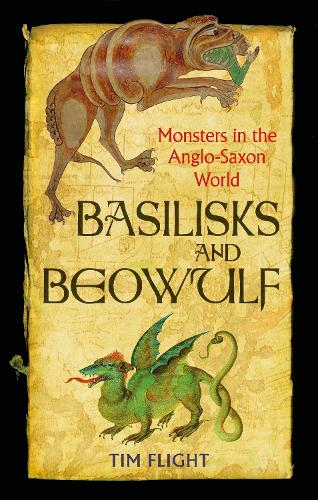

Why were the Anglo-Saxons obsessed with monsters,many of which did not exist Drawing on literature and art,theology and a wealth of first-hand evidence,Basilisks and Beowulf reveals a people huddled at the edge of the known map,using the fantastic and the grotesque as a way of comprehending the world around them.For the Anglo-Saxons,monsters helped to distinguish the sacred and the profane; they carried God's message to mankind,exposing His divine hand in creation itself. At the same time,monsters were agents of disorder,seeking to kill people,conquer their lands and challenge what it meant to be human even. Learning about where monsters lived and how they behaved allowed the Anglo-Saxons to understand their place in the world,as well as to apprehend something of the divine plan. It is for these reasons that monsters were at the very centre of the Anglo-Saxon worldview. From map monsters to demons,dragons to Leviathan,we neglect them at our peril.
MEDIA REVIEWS
Publisher: Reaktion BooksISBN: 9781789147742Dimensions: 198 x 129 mm
MEDIA REVIEWS
'Uncharted territories were not valued for their splendour,but feared for the malign forces they hosted. TimFlight's book covers the range of creatures that,in the Anglo-Saxonimagination,make their home in such landscapes. From the mysteriousblemmyes,headless men with eyes on their chest,to cynocephali (literally,"dog-headed"),human-canine hybrids with cannibalistictendencies,it shows how the monstrous is associated with the "corruption of God's design"- or,to put it another way,creatures thatare almost like humans or animals,but not quite...Flight's book is at its best when it explores this early medievalobsession with reinforcing and policing boundaries,and how it feedsinto imperial and colonial projects of the time. Demon-fighting iscompared with colonial expansion; defending the self against monstersbecomes a matter of national security.'- TLS;'Monsters abound in the literature and art of Anglo-Saxon England. From the most famous work of Old English literature,Beowulf,which relates the adventures of a monster-slaying hero,to hagiographies that narrate encounters between saints and devils,strange creatures are everywhere in England's early Middle Ages. In Basilisks and Beowulf,Tim Flight describes these monsters and analyses their role in the Anglo-Saxon worldview...it's well worth the time of anyone interested in the history of monsters.'- Fortean Times;'A bold and wide-ranging expedition into the wildest corners of the early medieval mind; Flight skilfully conjures the primal fears and ancientwonders that once lurked in England's shadowed groves and hollows.'- Thomas Williams,author of Viking Britain: A History;'Although he wears his learning lightly,Tim Flight covers an impressive amount of ground to bring us histhoughtful,stimulating account of monsters in the early medieval world. Moving from Beowulf's historical context,through maps,wolves,dragons,devils,and the Grendelkin to present-day fears,Basilisks and Beowulf opens up a strange and yet hauntingly familiar world to anyone who has readthe poem or any of its multitudinous offspring.'- Dr Jennifer Neville,Royal Holloway,University of London;'Immensely readable,thought-provoking and entertaining,this book is a splendid introduction to the though-world of the early English.'- Carolyne Larrington,BBC History Magazine;'In this exploration of Anglo-Saxon monsters,Flight exhibits a deep knowledge of the Anglo-Saxon corpus and brings together a broad assortment of texts. Flight focuses on the dichotomy between wilderness - the domain of monsters - and civilization. In engaging prose,he explores how the boundaries between these domains shaped Anglo-Saxon perceptions of monsters. Whereas scholarly consideration of Anglo-Saxon monsters generally focuses on Beowulf,Flight includes works in which monsters are featured less conspicuously,such as the sea life in The Seafarer,St. Cuthbert's battles against demons,and the etchings of curious monsters on Franks Casket (an early-eighth-century chest). But Flight certainly does not neglect Beowulf. He offers insight into symbolic representations of the dragon and the Grendelkin; the latter infiltrate the peace at Heorot and are,like St. Christopher in the Nowell Codex,part human. Flight also considers the hero Beowulf himself,whose size and strength render him akin to,though not part of,the realm of monsters. Other topics include wolves,map monsters,dragons,and whales,and a concluding chapter brings into discussion modern monsters such as Bigfoot and big cats in the UK. Recommended.'-Choice
Kommentar