


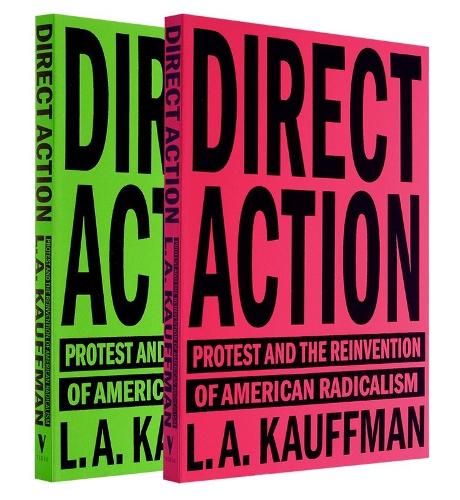

A vibrant,groundbreaking history of American radicalism since the SixtiesWhat happened to the American left after the Sixties This engrossing account traces the evolution of disruptive protest over the last 40 years to tell a larger story about the reshaping of American radicalism,showing how the direct-action blockades,occupations,and campaigns of recent activist movements have functioned as laboratories for political experimentation and renewal.Propelled by more than 100 candid interviews conducted over a span of decades,this elegant and lively history showcases the voices of key players in an array of movements - environmentalist,anti-nuclear,anti-apartheid,feminist,LGBTQ,anti-globalization,racial-justice,anti-war,and more - across an era when American politics shifted to the right,and issue- and identity-based organizing eclipsed the traditional ideologies of the left. As Kauffman,a longtime movement insider,examines how groups from ACT UP to Occupy Wall Street to Black Lives Matter have used direct action to catalyze change against long odds,she details the profound influence of feminism and queerness on radical political practice and how enduring divisions of race have shaped the landscape of activism. Written with nuance and humor,and revealing deep connections between movements usually viewed in isolation,Direct Action is essential reading for anyone interested in understanding how protest movements erupt - and how they can succeed.
MEDIA REVIEWS
Publisher: Verso BooksISBN: 9781784784096Number of pages: 256Weight: 280 gDimensions: 198 x 129 x 18 mm
MEDIA REVIEWS
It is impossible to overstate the importance of this book. Chances are that even if you know something about the recent history of the left in America,you probably only know a few isolated parts. L.A. Kauffman has connected a vast field of dots to create an overview,and she has done so with dispatch,clarity,and elegance. Her book is essential reading for today,and will be for tomorrow.As the new political reality settles in,resisters are asking a follow-up question: What else can I do L.A. Kauffman's new book Direct Action provides some answers.L.A. Kauffman may have the best-timed book release in years.L.A. Kauffman's Direct Action: Protest and the Reinvention of American Radicalism is the best overview of how protest works - when it does - and what it's achieved over the past 50 years.A movement tour de force. A must-read for those who have committed themselves to the life of the mind and of struggle.You could not ask for a better guide through recent social movement history than L.A. Kauffman. A champion of radical causes with decades of experience on the front lines of civil disobedience,she chronicles the fascinating evolution of a set of protest tactics today's activists take for granted. Kauffman has done a tremendous public service: by helping us better understand the past,in all its glory and folly,we can be more effective dissidents and rabble-rousers tomorrow. This startling,inspiring book is for anyone who has ever felt the urge to put their body on the line and shut things down for something they believe in.The lurid circus sideshow has seized center ring in Washington,making direct action by progressive agitators all across the country more essential than ever. Don't agonize,organize! How to do it Kauffman's powerful book,drawing on our people's recent history,shows the way to create true justice for all.If direct action is'a laboratory for political experimentation and innovation,'as Kauffman argues in the introduction,then this is the lab report.Kauffman,an important and experienced organizer,senses in Occupy,Black Lives Matter and perhaps even the Bernie Sanders campaign new political oxygen,locally-based movements that cannot be effectively controlled or easily squashed.In Direct Action: Protest and the Reinvention of American Radicalism,L. A. Kauffman assesses movements of the past half century not as scattered uprisings but as phases of an overarching project...Our current radical-action culture,she thinks,really started in the early seventies,when a new generation of green shoots rose up from the ash.In a genuinely invigorating book for these times,L. A. Kauffman positively reassesses the efficacy of leftist protest movements since the'60s,beginning with a re-examination of the'60s itself. This book is a must-read for anyone looking for a way forward.This intricate book deserves careful reading. Far from being just a catalogue of actions,it traces the ways in which radical movements,linked by their use of civil disobedience,have adapted to contemporary demands.L.A. Kauffman's valuable book,Direct Action,is both a thematic history of a period and a dramatic exploration of the chaning repertoire of protest tactics used by the American movements of the radical left. Beginning with the May 3,1971 "Mayday" anto-Viet-Nam War demonstration in Washington,DC,the book concludes with Black Lives Matter and the use of direct action in the 2014 resistance to racist police practices in Ferguson,Missouri. Consideration of times and techniques is integrated into four roughly chronological chapters which answer the book's essential question: "What happened to the American left after the sixties"At a time when socialism has reentered the political vocabulary,it is wonderful to have this engaging book,introducing old-timers and a new generation to the greatest American socialist,Eugene V. Debs. A beloved labor leader,tireless battler against economic inequality,and defender of free speech,Debs's radicalism and commitment to social justice are more needed today than at any time since his death.
Kommentar