


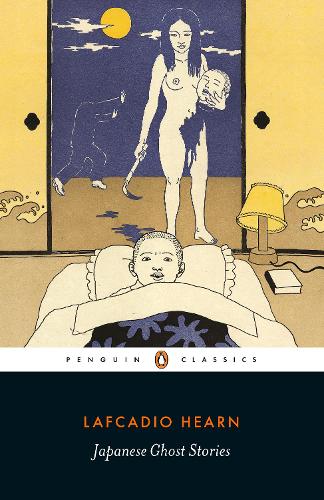

Thedead wreak revenge on the living,paintings come alive,spectral bridespossess mortal men and a priest devours human flesh in these chillingJapanese ghost stories retold by a master of the supernatural. LafcadioHearn drew on the phantoms and ghouls of traditional Japanese folklore -including the headless'rokuro-kubi',the monstrous goblins'jikininki'or the faceless'mujina'who stalk lonely neighbourhoods - and infusedthem with his own memories of his haunted childhood innineteenth-century Ireland to create these terrifying tales of strikingand eerie power. Today they are regarded in Japan as classics in theirown right.Edited with an introduction by Paul Murray
Publisher: Penguin Books LtdISBN: 9780241381274Number of pages: 272Weight: 202 gDimensions: 198 x 129 x 16 mm
MEDIA REVIEWS
The particular value of Murray's collection is that it leads us in chronological order through a much greater breadth of Hearn's writings on the supernatural in Japan,with ghostly tales selected from 11 of his books...This book insightfully shows how Hearn filtered Japanese ghostly originals through the prism of his own expansive imagination and traumatized experience to create works that were distinctly,and chillingly,his ownWhat makes these stories,preserved from ancient times,especially readable today is the preternaturally postmodern form they are given in Hearn's deeply idiosyncratic tellingThe overarching mood is of wonder...the stories occupy the reverie world our mind projects onto the backs of our eyelids,where the ordinary mingles with the supernaturalAn extraordinary author...Paul Murray,a former Irish diplomat,has been hooked since a 1970s posting in Japan. His Penguin compilation includes 34 selections,a chronology of Hearn's peripatetic life,some intriguing background information about the sources of the stories,and a number of evocative woodblock prints. Murray's introduction is exceptionally useful to contextualize the man and his oeuvre,tracing the powerful influence of Irish folktales and ghost stories on Hearn's take on Japanese counterparts
Kommentar