


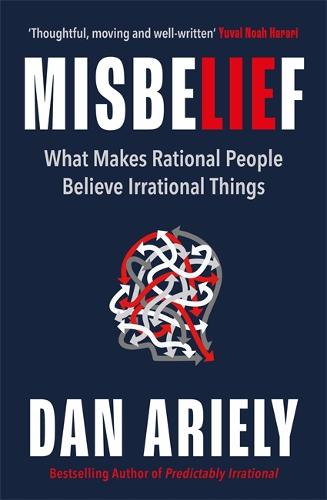

'Thoughtful,moving and well-written'- Yuval Noah Harari'An urgent examination of the human attraction to misinformation'- Daniel H. PinkMisinformation affects us daily,from social media to politics and even personal relationships. Policing social media alone cannot solve the complex problem shaped by partisan politics and subjective interpretations of truth.In Misbelief social scientist Dan Ariely explores the behaviour of'misbelief'that leads people to distrust accepted truths and embrace conspiracy theories. Misinformation taps into something innate in all of us,regardless of political affiliation. By understanding this psychology,we can mitigate its effects. Grounded in research and Ariely's personal experience as a target of disinformation,the book analyses the psychological drivers behind adopting irrational beliefs. Ariely reveals the emotional,cognitive,personality,and social elements that drive people towards false information and mistrust.Despite advanced AI generating convincing fake news,Ariely offers hope. Awareness of the forces fuelling misbelief makes individuals and society more resilient. Combating misbelief requires empathy,not conflict. Recognising misbelief as a human problem allows us to be part of the solution.
Publisher: Bonnier Books LtdISBN: 9781785120763Number of pages: 352Weight: 536 gDimensions: 240 x 162 x 31 mm
MEDIA REVIEWS
'In this thoughtful,moving and well-written book,Dan Ariely narrates his personal and professional journey to understand the world of misbelievers and conspiracy theories,and offers insights and tips that will hopefully help all of us protect our fragile social fabric from being torn apart by disinformation and distrust.''Misbelief is an urgent examination of the human attraction to misinformation. This timely book can provide a crucial foundation for building a more empathetic and informed society.''Once again Dan Ariely writes in a way that gets us to think and reflect about our human nature. In Misbelief,Ariely helps us understand the nature of our opinions,how they're formed,and how the forces of misinformation can distort them. This is an important book for those who want to understand themselves and the increasingly complex world around us.''For most of us it is tempting to think that people misbelieve things because they are uneducated,unintelligent,or misinformed. But as one of the world's leading scientists studying beliefs,Dan Ariely,convincingly demonstrates in this important book (and as he discovered first hand in being wrongly accused of leading a nefarious conspiracy!),Misbelief is a process to which any of us can fall prey. More importantly,he offers science-based suggestions on what we can do about the polarization and breakdown in trust that comes with Misbelief.''A fascinating tour of the (frighteningly) many ways in which our minds can lead us to misbelieve.''Dan Ariely does to false beliefs what he did to rationality - breaks it down,explains it,and builds it back up in a way that suddenly makes sense.''The global economy is experiencing multiple types of fundamental challenges and threats. From trade wars to cold and hot wars to inflation to climate change and productivity slowdown. In Misbelief Dan Ariely identifies another important challenge,which is the increased intensity in false beliefs across the globe,the decrease in trust,and,consequently,the difficulties of societies to work together toward a common goal. Although complex and somewhat depressing,the perspective Ariely shares sheds an important light on this crucial challenge for modern society. A must read for anybody trying to understand the world we live in.''In an era marked by misinformation this illuminating book,Misbelief,is a must-read for both sides of our divided world. Ariely explores the profound impact of misguided beliefs with compelling research,personal anecdotes,and amusing stories. He convincingly shows how Misbelief shapes decisions,distorts perceptions,and alters interactions,prompting readers to confront their own biases and reflect on the dangers of unquestioned assumptions.'
Kommentar