


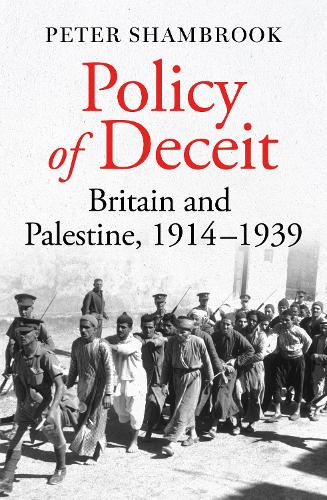

'A magnificent new book...a major historical achievement'
Peter Oborne,Middle East Eye
In this eye-opening book,Peter Shambrook delves into the secret correspondence between the British High Commissioner in Egypt,Sir Henry McMahon,and the Sharif of Mecca during the First World War. McMahon promised the Sharif an independent Arab state,including Palestine,after the war,in exchange for his alliance with Britain against the Ottomans. But what happened next changed the course of history.
Despite the promises made,two years later Lloyd George's government declared that Palestine would be for the global Jewish community. Shambrook's meticulous analysis of official records and private papers reveals the behind-the-scenes machinations that led to this betrayal of the Arabs and exposes how successive British governments blocked the publication of the Sharif and McMahon's correspondence.
Presenting compelling evidence,Shambrook debunks the myth perpetuated by Britain and pro-Zionist historians that Palestine was never part of the lands guaranteed to the Sharif. He lays bare the truth and its devastating consequences,which have reverberated throughout the decades-long conflict in the Middle East. Shockingly,no British government has launched an impartial investigation into this matter or officially acknowledged its betrayal of the Palestinian people.
This definitive work is a must-read for anyone interested in the history of the Israel-Palestine conflict,revealing a hidden chapter of British deceit and shedding light on the ongoing tensions in the region.
Publisher: Oneworld PublicationsISBN: 9780861546329Dimensions: 234 x 153 x 35 mm
MEDIA REVIEWS
'Magnificent... Shambrook's book is a major historical achievement. He has solved the mystery of the sharif/McMahon agreement. He has overturned the century-long British narrative that Palestine was excluded from the agreement with the sharif. He has also disposed of the notion,promoted by scholars from Albert Hourani to Martin Gilbert,that the truth about the agreement was mysterious or elusive. More than that,he has shown that the sharif/McMahon correspondence may have contained greater legal weight than the famous promise to the global Jewish community two years later in the shape of the Balfour Declaration,which was a statement of intent and not (officially at any rate) an agreement between two parties.'
'Deeply researched,powerfully argued and meticulously documented,Policy of Deceit lays bare Britain's shameful record of lies,broken promises and betrayals that paved the way to the Zionist takeover of Palestine. It also suggests that an official British apology to the Palestinians is long overdue. A strikingly fair-minded book about one of the shabbiest and most sordid chapters in the history of the British Empire.'
'Policy of Deceit is the definitive scholarly work on the McMahon-Hussein correspondence and its afterlives. With this empirically rich and analytically rigorous book,Shambrook makes an important contribution to the study of Britain's direct responsibility for the dispossession of the Palestinian people.''Basing his narrative on painstaking archival research,Peter Shambrook shows precisely how British policymakers dodged and weaved in order to make the claim that Palestine was never included in the Hussein-McMahon agreement. His forensic dissection of this particular "policy of deceit"is an important contribution to the historiography of British rule in Palestine.'
'Based on extensive research and a thorough survey of the relevant literature,this book grapples with the 100-year-old debate over whether Palestine was included in the territories that the British pledged to Hussein ibn Ali Sharif of Mecca,concluding that Palestine was indeed a twice-promised land. By unravelling why the truth has never been acknowledged by any British government,this revealing study sheds important light on the history of Arab-British relations. It is essential reading for anyone interested in understanding the roots of the tension between the Arab world and the West.'
'This is the most comprehensive and incisive exposure of the origins of the British betrayal of Palestine. Based on thorough archival research,it brings to a close an old historiographical debate by showing clearly that Britain pledged to make Palestine part of the Arab world during the First World War,and it reveals why this promise was concealed from the British public. Not only is this a vital correction regarding a crucial moment in Palestine's history,it is also a call for contemporary Britain to acknowledge and apologise for its treachery towards the Palestinians.'
'In this thorough and incisive piece of historical detective work,Peter Shambrook conclusively scotches some of the myths and delusions that for over a century have surrounded Britain's handling of the future of Palestine. The Balfour Declaration of 1917,Shambrook shows in lucid detail,was incompatible with the commitment made by the British two years earlier to Hussein ibn Ali,the Sharif of Mecca,that Palestine would come under independent Arab rule. A riveting account of a long-running saga of British double-dealing and evasion,Policy of Deceitis a rigorous,accessible and important contribution to theliterature on Britain's imperial role in the Middle East. The roots of the continuing conflict between Jews and Palestinians there,Shambrook shows,were "made in Britain".'
'Crisply,forensically and objectively,Policy of Deceit refutes once and for all the contention that Britain excluded Palestine from the Arab lands to which it pledged independence in the 1915-16 correspondence with the Sharif of Mecca.'
'Shambrook revisits the controversies around the Hussein-McMahon Correspondence of World War I,when the British government convinced the Sharif of Mecca to launch an Arab revolt against the Ottoman Empire in return for the promise that Britain would recognise Arab independence after the war. He concentrates on the key question in the Correspondence debate: was Palestine included in Britain's promise to Sharif Hussein Dr Shambrook's extensive research into a variety of public records,private papers and memoirs leads him to conclude that the British government not only included Palestine in its promise but also lied about it all along. Historians will find a refreshing reassessment of claims to the contrary made by such prominent historians as Isaiah Friedman and Elie Kedourie. Shambrook's conclusions will doubtless generate new debate about Britain's role in fostering one of the most bitter international conflicts of the past 100 years.'
'Shambrook's deft handling of the primary sources brilliantly brings to life how British imperial officials and politicians contrived to determine then defend an increasingly problematic policy in Palestine.'
'A thorough examination of a subject with profound and ongoing ramifications.'
'Peter Sambrook,who has a doctorate in modern Middle Eastern history has attempted to settle the account once and for all by doing more research than almost any other historian (creating) a fluent and readable account.'
'Peter Shambrook's forensic analysis of primary sources in this country's dealings with Arab leaders,particularly in the correspondence of 1915-17,should finally nail the issue of Britain's double-dealing and lead to an honest acknowledgement of Britain's failures... Palestine was a twice-promised land,and Britain's dishonest dealings are irrevocably revealed in the author's detailed exploration.'
Kommentar