


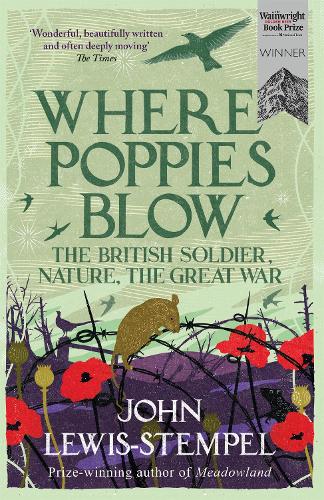

Winner of theWainwright Golden Beer Book Prize 2017
The natural history of the Western Front during the First World War by the author ofMeadowland,winner of the 2015 Wainwright Prize
There was no escape from nature a century ago. In the trenches,soldiers actually habited the bowels of the earth,in direct and myriad contact with all flora and fauna of Flanders and the Somme. Nature was all around,in every one of Its/His/Her guises. There could only be heightened awareness of nature when at war.
Where Poppies Blowis the unique story of the British soldiers of the Great War and their relationship with the animals and plants around them.
This connection was of profound importance,because it goes a long way to explaining why they fought,and how they found the will to go on. At the most basic level,animals and birds provided interest to fill the blank hours in the trenches and billets - bird-watching,for instance,was probably the single most popular hobby among officers. But perhaps more importantly,the ability of nature to endure,despite the bullets and blood,gave men a psychological,spiritual,even religious uplift.
Animals and plants were also reminders of home. Aside from bird-watching,soldiers went fishing in village ponds and in flooded shell holes (for eels),they went bird nesting,they hunted foxes with hounds,they shot pheasants for the pot,and they planted flower gardens in the trenches and vegetable gardens in their billets. It is in this elemental relationship between man and nature that some of the highest,noblest aspirations of humanity in times of war can be found.
'What makes Where Poppies Blow so freshly moving is the picture it paints of the reverence,love and kindness the natural world can engender,even in the most hellish conditions'- The FT
Publisher: Orion Publishing CoISBN: 9781780224916Number of pages: 400Weight: 284 gDimensions: 128 x 197 x 26 mm
MEDIA REVIEWS
'What makes Where Poppies Blow so freshly moving is the picture it paints of the reverence,love and kindness the natural world can engender,even in the most hellish conditions; as Philip Gosse of the Royal Army Medical Corps called it,"medicine for the mind and solace for the soul"''In Where Poppies Blow, the nature writer,historian and farmer presents us with a beautiful and meticulous account of soldiers'relationship with nature...This book,which recounts the lives of our frontline soldiers from the ground up,is a truly wondrous and original work with an appeal far beyond military history''Wonderful,beautifully written and often deeply moving''Makes an important contribution to the literature by studying the British soldiers'relationship with Nature...Moving,strangely life-affirming''Manages what might have seemed impossible: to find a new perspective on the Great War''From traumatized,trench-bound British soldiers caught up in the carnage of the First World War,birdwatching and botany offered solace. So reveals John Lewis-Stempel in this riveting study drawing on verse,letters and field notes by men who served,from zoologist Dene Fry to poet Edward Thomas...A remarkable picture of a human bloodbath that took place amid phenomenally rich biodiversity''Deeply moving...I finished this book marvelling at nature's healing power''But natural history did not go into suspense while war was waged.Where Poppies Blow notes that many of the Edwardian boys who ended up on the Western Front still collected birds'eggs and butterflies''Memorable''One of the best nature writers to have come along in many years,John Lewis-Stempel turns his attention here to the relationship between soldiers and nature on the Western Front during the First World War''Nature writer and military historian John Lewis-Stempel has created a eulogy to the flora and fauna that helped men soldier on during the First World War...Where Poppies Blow is full of fascinating (sometimes heart-wrenching) information about the role of nature and animals in this brutal war''This charming book reminds us that flora and fauna weren't suspended by the First World War'- 5 starsUnmissable...John Lewis Stempel is both a working farmer and a prizewinnig author.In early July,i heard him speak on first world war soldiers and their love of flowers and animals.I went straight off and read his excellent book,Where Poppies Blow,and I defy you not to be moved by its chapters on flowers and dogs.Shows how important birdwatching was to officers in particular,and how this in turn fed back into post-war ornithology.It's an enthralling,and often moving,read,that sets the study and enjoyment of wildlife in a much wider context.Ultimately,the depth and power of Where Poppies Blow is impossible to convey.It eludes review,but it begs to be read.
John Lewis-Stempel
Widely recognised as one of Britain's finest natural history writers,John Lewis-Stempel is a farmer,journalist and writer whose works include The Wild Life,Meadowland,Where Poppies Grow,The Running Hare and The Secret Life of the Owl. He is a two-time winner of the Wainwright Golden Beer Book Prize for Nature Writing.
Visit the John Lewis-Stempel author page
Kommentar